



On July 15, 2026, the U.S. Department of Commerce opened an annual administrative review of the antidumping duty order covering hot-dip galvanized steel sheet (HDG) from China. For companies involved in exporting, importing, sourcing, customs handling, and supplier approval, this matters less as a headline event and more as a live rule process: the review can reset company-specific rates and may also affect the nationwide rate, which means landed cost assumptions and supplier decisions for the U.S. market could shift from Q3 onward.
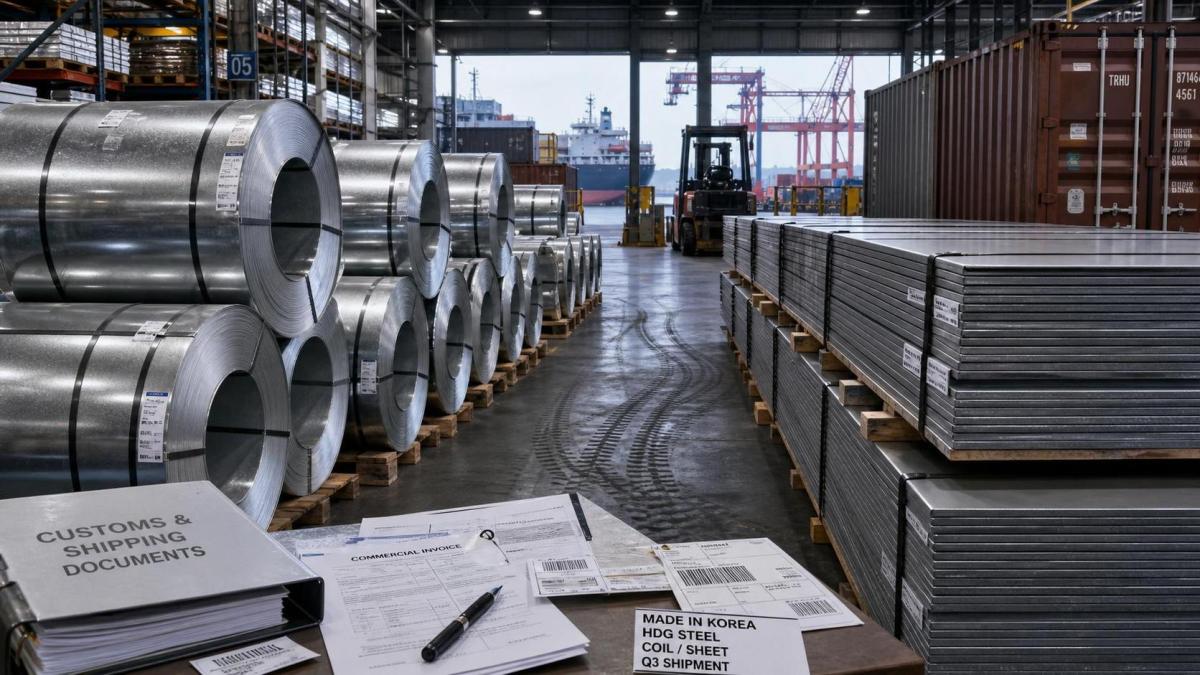
What the announced review covers
The announced action is an annual administrative review tied to the antidumping duty order on Chinese-origin HDG. According to the provided event summary, the review applies to exports shipped during the period from July 1, 2025 to June 30, 2026.
The review was formally initiated by the U.S. Department of Commerce on July 15, 2026. Its stated function is to recalculate individual dumping duty rates for exporters under review, while also leaving open the possibility of an adjustment to the nationwide rate.
Based on the provided information, the result is expected in September 2026. The stated area of immediate relevance is U.S. import clearance cost, procurement budgeting, and supplier access assessment starting in Q3.
Where the pressure may appear across the supply chain
Import-side budgeting and customs planning
From an industry perspective, U.S. importers are among the first parties likely to feel the operational effect because any rate change can alter the duty burden attached to incoming HDG shipments. The main exposure is in customs cost forecasting, internal budget allocation, and timing of purchase decisions. What deserves closer attention is whether current landed-cost models, broker instructions, and supplier selection criteria remain workable if reviewed rates move.
Exporter exposure in customer retention and price talks
Analysis shows that exporters shipping Chinese-origin HDG to the U.S. market may face renewed scrutiny from buyers once individual rates are recalculated. The impact is not limited to pricing; it can also affect supplier qualification, quote validity, and the credibility of delivery commitments tied to U.S.-bound orders. Companies in this position should pay close attention to the way shipment records, trade documents, and customer-facing compliance materials are prepared and presented during the review cycle.
Procurement and manufacturing coordination
For procurement teams and downstream manufacturers that rely on HDG inputs, the issue is less about the legal process itself and more about whether sourcing assumptions remain stable. If duty exposure changes, procurement departments may need to revisit supplier comparisons, order timing, and the cost basis used in production planning. Observably, this can also influence contract discussions where delivery windows and price adjustment clauses are sensitive to import cost changes.
Supply chain service providers and commercial documentation
Logistics coordinators, customs service providers, and trade compliance teams may also need to watch the review closely. Their role becomes more important when importers ask for clearer shipment documentation, product identification, and supplier-related records to support clearance planning and internal compliance review. It is more appropriate to understand this as a documentation and execution risk issue rather than a purely policy issue.
Practical points companies should track now
Watch for official wording and timing
Analysis shows that the most immediate task is to monitor how the review continues to be described in official updates, especially around rate determination and the expected September 2026 outcome. The current information confirms the start of the review and its scope, but it does not yet provide a final execution result.
Recheck supplier approval assumptions
Companies using Chinese-origin HDG for the U.S. market should revisit whether existing supplier approval decisions were built on current duty assumptions that may no longer hold. This is particularly relevant where sourcing decisions depend on stable import cost, customs predictability, or internal compliance thresholds.
Prepare records tied to shipments and commercial terms
What deserves closer attention is the readiness of shipment-period records, trade documents, and related technical or commercial files that support procurement, clearance, and customer review. The provided information does not set out new documentation rules, so this should be treated as a compliance watchpoint rather than a confirmed new filing requirement.
Review Q3 purchasing and delivery exposure
Observably, companies with Q3 purchasing plans, delivery commitments, or customer quotations linked to U.S. imports may need to test whether current assumptions still work under a revised rate environment. This is not yet a confirmed outcome, but the expected September 2026 result means planning teams have a clear reason to stress-test procurement and delivery scenarios now.
Why this looks more like an execution signal than a final outcome
Analysis shows that this development should not be read as a completed rule change, because the review has been initiated but the new rates have not yet been announced. At the same time, it is more than a routine procedural notice for affected businesses. The review sends a concrete execution signal that duty exposure tied to Chinese-origin HDG remains active and commercially relevant for U.S.-facing trade decisions.
From an industry perspective, the key point is that the market may begin adjusting before final results are published. Buyers, sourcing teams, and compliance functions often respond to the possibility of rate movement by tightening supplier review, updating cost assumptions, and seeking clearer documentation. That makes this a development that still requires observation, but one with immediate planning consequences.
How the market should read the current development
The most balanced reading is that the July 15, 2026 announcement marks an active review phase with potential cost and qualification effects, not a settled trade outcome. Its significance lies in the fact that company-specific and nationwide rates may be recalculated, with direct implications for import cost management and supplier assessment in the U.S. market.
Current attention is best focused on preparedness: tracking the review timeline, checking procurement and clearance assumptions, and watching how market participants respond once the expected September 2026 result approaches. It is more appropriate to understand this as a developing trade-rule event that already matters operationally, while still requiring continued verification before final conclusions are drawn.
Basis of this article and what still needs verification
This article is generated from the user-provided news title, event date, and event summary. For developments of this kind, relevant source types usually include official notices, releases from regulatory or trade authorities, customs or trade administration updates, industry association communications, standard-setting documents, and reporting from authoritative trade media.
No specific official source link was provided in the input, so the exact official link still needs to be verified on an ongoing basis. Observably, the next points that require continued checking are any later official wording, the final rate outcome expected in September 2026, possible changes in procurement or tender documents, market-side compliance interpretation, and how affected companies implement their supply chain and import decisions.
By clicking 'Allow All', you agree to the storage of cookies on your device to enhance site navigation, analyze site usage and assist with our marketing efforts. Coo Cookie Notice