



On July 12, 2026, the European Commission brought into force a new implementation rule for carbon footprint disclosure on imported steel products. The change matters because it turns environmental documentation into a customs-facing compliance requirement for key structural steel categories, including hot-rolled coil, H-beams, and cold-formed sections. For importers, distributors, EPC procurement teams, exporters, and verification-related service providers, the immediate issue is no longer only product availability or price, but whether shipments are supported by an EPD and carbon footprint data aligned with EN 15804+A2 in a form that can withstand border review.
What the new requirement now covers
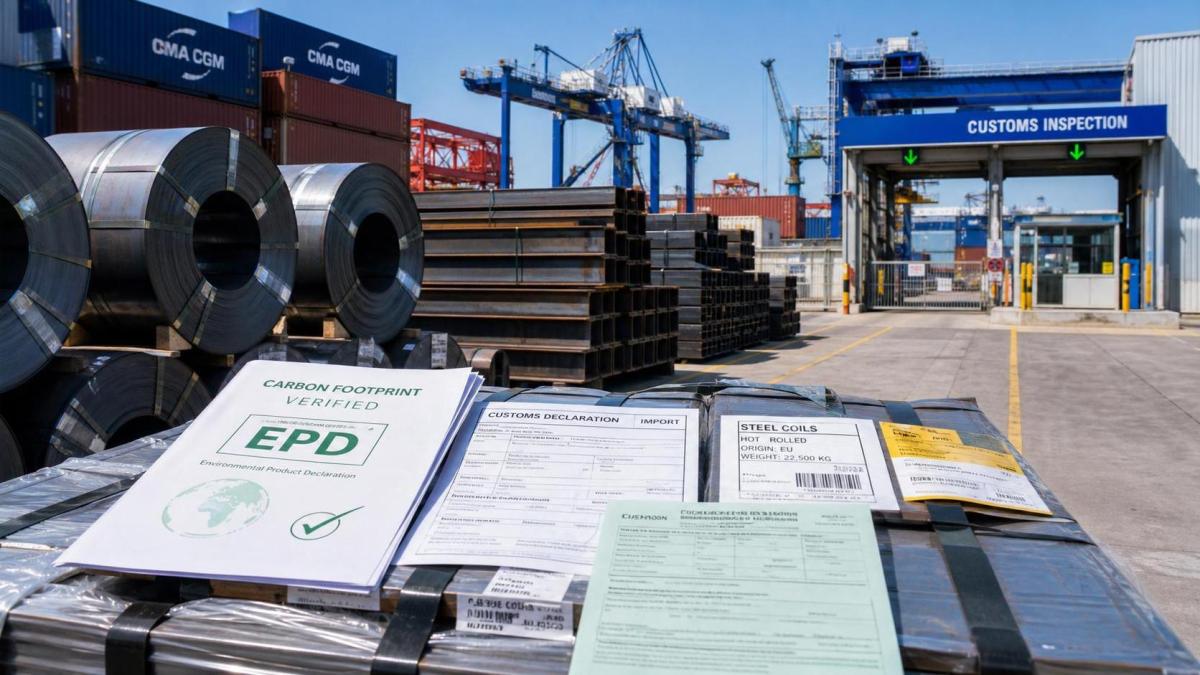
According to the information provided, the European Commission formally made effective the Implementing Rules for Carbon Footprint Disclosure of Steel Product Imports on July 12, 2026. The rule requires major structural steel products imported from China and other third countries, including hot-rolled coil, H-beams, and cold-formed sections, to be accompanied by an EPD issued by an accredited verification body and carbon footprint data compliant with EN 15804+A2.
The same information states that goods failing to meet the requirement may be denied customs clearance or be subject to additional inspection. The stated impact directly concerns market access compliance and delivery timing for global steel importers, distributors, and EPC project buyers.
Where the pressure is likely to appear across the chain
Import transactions are now more document-sensitive
From an industry perspective, steel importers are likely to feel the first direct impact because the rule links admissibility to supporting documentation. The practical concern is not only whether the material specification is correct, but whether the shipment package includes an acceptable EPD and carbon footprint data aligned with the stated standard. This shifts part of import risk from purely commercial negotiation into pre-shipment compliance review.
Distribution channels may see added checks before onward delivery
Distributors are also exposed because any interruption at customs can affect stock availability and order fulfillment. What deserves closer attention is the possibility that compliance review will become part of intake control for imported structural steel, especially where delivery commitments depend on continuous inbound flow. For this group, documentation completeness and traceability may become more relevant in day-to-day operations.
EPC procurement teams face a tighter link between buying and admissibility
For EPC project buyers, the change matters because procurement decisions may now need to account for whether a supplier can provide recognized environmental declarations and standard-aligned carbon data together with the product. Analysis shows that this can affect bid evaluation, supplier qualification, and delivery planning, particularly where structural steel is a schedule-critical input. The issue is less about a broad sustainability narrative and more about whether procured material can clear entry without delay.
Verification and compliance support functions may become more involved
The requirement also points to a larger role for organizations involved in verification, testing support, and compliance documentation. Observably, where accredited validation is required, exporters and buyers may need closer coordination with the parties responsible for issuing or checking product environmental declarations. Even without further execution details in the input, the rule clearly elevates the status of supporting compliance documents in steel trade flows.
What companies should watch in current practice
Check whether product scope and supporting files match the shipment
Companies dealing in affected steel products should focus on whether the shipped category falls within the covered structural steel range described in the information provided, and whether the corresponding EPD and carbon footprint data are available in the required form. This is a practical checkpoint for exporters, importers, and procurement teams before cargo movement or order confirmation.
Review supplier qualification through a compliance lens
Analysis shows that supplier review may need to move beyond technical specification and price. A supplier's ability to provide documentation issued by an accredited verification body, together with EN 15804+A2-aligned carbon footprint data, is now part of transaction reliability. Where this cannot be confirmed early, delivery timing and customs risk may become harder to manage.
Revisit bidding, purchasing, and contract documentation
What deserves closer attention is whether tender files, purchase terms, technical attachments, and delivery document lists reflect the new requirement. If project buyers or traders continue using older documentation checklists, the compliance gap may only become visible late in the shipment process. The information provided does not define detailed execution formats, so companies should treat this as an area requiring ongoing verification rather than assuming a settled market practice.
Allow for inspection risk in delivery planning
Because non-compliant cargo may be refused clearance or subjected to additional inspection, delivery schedules may need a wider compliance buffer. This does not prove that all shipments will face delay, but it does mean that customs-facing documentation quality can now influence fulfillment timing more directly than before. For businesses with tight project milestones, this is a planning issue as much as a regulatory one.
Why this looks more like an execution signal than a distant policy debate
Observably, this development is better understood as a rule that has entered the operational stage, not merely a policy direction under discussion. The effective date is specified, the covered product examples are identified, and the consequence for non-compliant goods is stated in customs terms. That gives the update immediate relevance for commercial and supply chain decisions.
At the same time, analysis shows that the market still needs to watch how the requirement is applied in practice. The input does not provide fuller detail on review procedures, documentation formats beyond the stated elements, or how consistently additional inspections may be used. For that reason, the change should be treated as a live compliance requirement with execution details still worth monitoring.
How the market may need to read this update now
This update points to a clear shift in steel import compliance: environmental product documentation and carbon footprint reporting are becoming part of the access condition for certain structural steel products entering the EU market. The immediate significance lies in customs clearance, supplier readiness, and delivery reliability rather than in abstract policy messaging.
It is more appropriate to understand this as a landed rule with practical trade implications, while still recognizing that companies will need to follow later clarification, market implementation, and document review practice. A measured reading is that the compliance threshold has already moved, but the full operating pattern around that threshold still requires close observation.
Basis of this article and points still requiring verification
This article is generated from the user-provided news title, event date, and event summary. In this type of development, commonly relevant source categories may include official notices, regulatory publications, customs or trade authority information, industry association updates, standards organization materials, and reporting by established trade media.
No specific official source link was provided in the input, so the exact official publication path still needs to be verified on an ongoing basis. Further observation should focus on implementing detail, certification and verification interpretation, changes in tender and procurement documents, market feedback, and how companies are executing the requirement in practice.
By clicking 'Allow All', you agree to the storage of cookies on your device to enhance site navigation, analyze site usage and assist with our marketing efforts. Coo Cookie Notice