


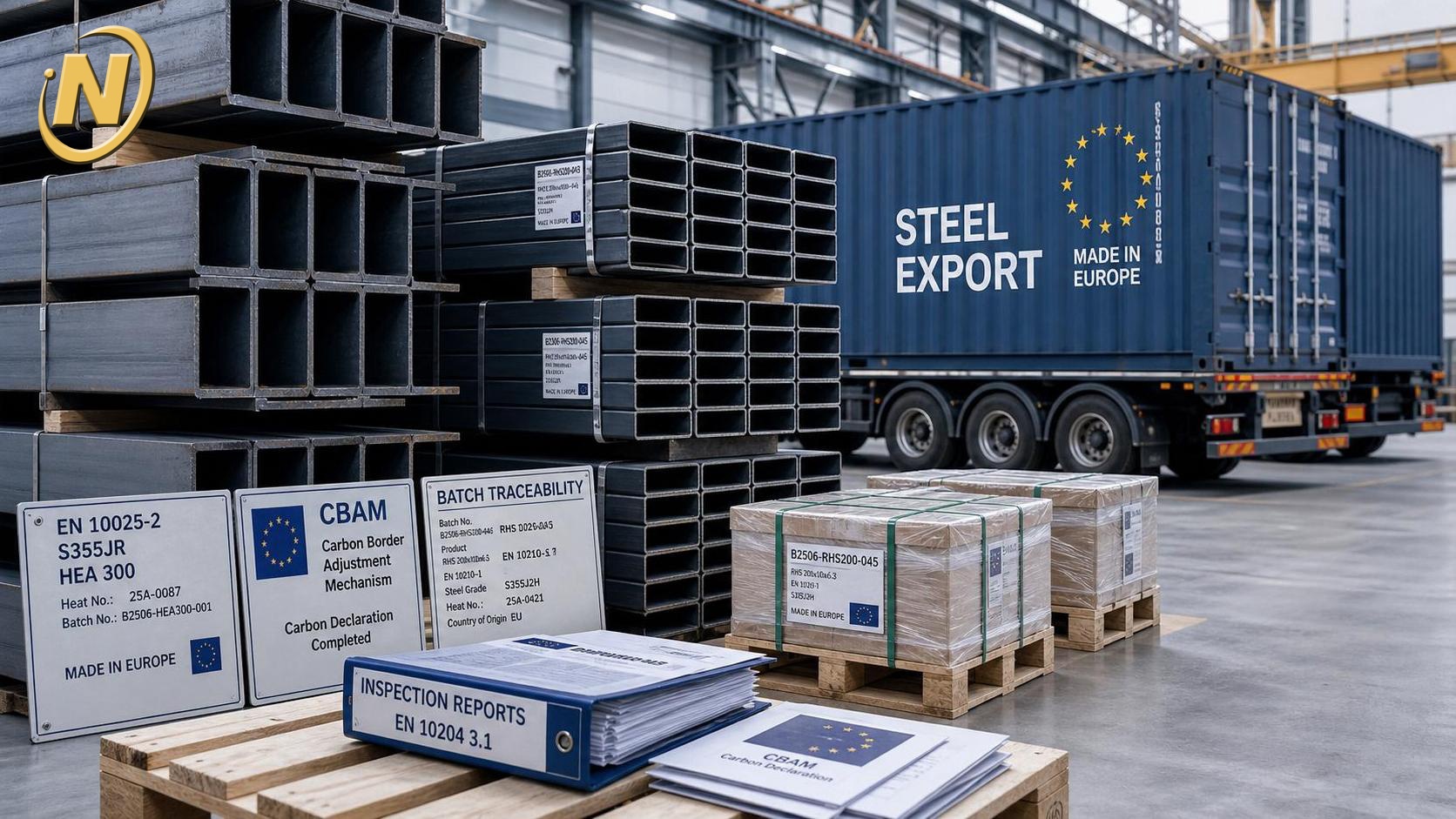
On June 28, 2026, the European Commission released transition-period implementation rules for CBAM covering steel products, setting a clear compliance signal for Chinese exporters of sections such as hot-rolled H-beams and cold-formed rectangular tubes. From October 1, 2026, shipments to the EU in these product categories will need batch-level embedded carbon emissions data and a third-party verification report filed through the CBAM registration system, making customs clearance, export documentation, and delivery coordination immediate points of concern for exporters, suppliers, and buyers.

What the new filing requirement confirms
The confirmed facts are limited but operationally important. The European Commission formally issued the transition-period implementation rules for CBAM steel products on June 28, 2026. The rules specify that, starting on October 1, 2026, exporters of steel sections shipped to the EU, including hot-rolled H-beams and cold-formed rectangular tubes, must submit the embedded carbon emissions data for each batch through the CBAM registration system together with a third-party verification report. The measure covers major Chinese steel exporters. The event summary also states that non-compliant declarations may lead to customs clearance delays or refusal of acceptance.
Where the pressure is likely to appear first
Export transactions move from product shipment to data-backed shipment
From an industry perspective, exporters are the first group directly exposed because the rule links shipment to batch-based carbon disclosure and external verification. The main impact is not only on customs-facing paperwork, but also on whether a shipment file is complete before dispatch. What deserves closer attention is the need to align product batches, emissions information, and verification materials in a form that can be submitted through the CBAM system.
Manufacturing and processing stages face a documentation burden
For mills and processors producing the covered sections, the practical issue is that product output now connects more tightly to traceable emissions data. Analysis shows that the rule may affect how production records, batch segregation, and supporting technical files are prepared for export orders. Even where the sales contract sits with a trading company, the underlying production-side records may become essential for completing the required submission set.
Buyers and supply-chain coordinators may tighten document expectations
For EU-facing buyers, traders, and logistics coordinators, the rule creates a stronger reason to check whether carbon data and third-party verification are available before cargo handover. The likely impact falls on order confirmation, shipping readiness, and document review. Observably, the risk noted in the event summary is not abstract: where declarations are incomplete, the shipment may face delay or rejection at the clearance stage.
What companies should track before October
Readiness of batch-level carbon data
Analysis shows that companies shipping covered steel sections should pay close attention to whether internal records can support batch-by-batch emissions reporting rather than only product-level or order-level descriptions. This is especially relevant where multiple plants, processing steps, or subcontracting arrangements are involved.
Availability and timing of third-party verification
The summary confirms that a third-party verification report is required, which means compliance work does not end with internal calculation. What deserves closer attention is scheduling, file completeness, and whether verification can be obtained in step with shipping plans. Since the provided information does not include further execution detail, this should be treated as a monitoring point rather than a settled operating standard.
Consistency between trade documents and CBAM submission
Exporters and supply-chain teams should also focus on the consistency of shipment documents, product descriptions, and CBAM filing materials. Analysis shows that any mismatch between batch identification, product category, and supporting reports may create friction during customs handling or customer acceptance, even if the cargo itself is physically ready.
Contracting and delivery rhythm with EU customers
Observably, the rule may begin to affect delivery planning before the October start date because parties may revise document checklists or order conditions in advance. Companies should therefore watch for changes in customer document requests, tender wording, and shipment preconditions, while avoiding assumptions about uniform enforcement until more execution feedback becomes visible.
Why this looks more like an execution signal than a distant policy headline
Analysis shows that this development is better understood as a concrete execution signal rather than a broad policy discussion. The reason is that the event summary identifies a start date, named product examples, a reporting channel, and required supporting material. At the same time, it is not yet a complete picture of how every practical question will be handled in trade flows, so continued attention is still needed on filing practice, verification interpretation, and market response once shipments begin moving under the new requirement.
How the market may need to read this stage
At this stage, the announcement is most appropriately understood as a rule change with near-term operational consequences for steel section exports to the EU. It does not by itself confirm how all counterparties will implement the requirement in daily business, but it clearly moves carbon reporting from a general compliance topic into shipment preparation and clearance risk management. For the industry, the immediate significance lies in document readiness, verification coordination, and delivery execution rather than in broad market claims.
Basis of this article and what still needs checking
This article is based on the user-provided news title, event date, and event summary. For events of this type, relevant source categories usually include official announcements, releases by regulatory bodies, customs or trade administration information, industry association notices, standards-related documents, and reporting by authoritative media. A specific official source link was not provided in the input, so it still needs to be verified on an ongoing basis. Further observation should focus on detailed implementation wording, verification practices, changes in tender or procurement documents, market feedback, and how companies execute the requirement in actual export operations.
By clicking 'Allow All', you agree to the storage of cookies on your device to enhance site navigation, analyze site usage and assist with our marketing efforts. Coo Cookie Notice