


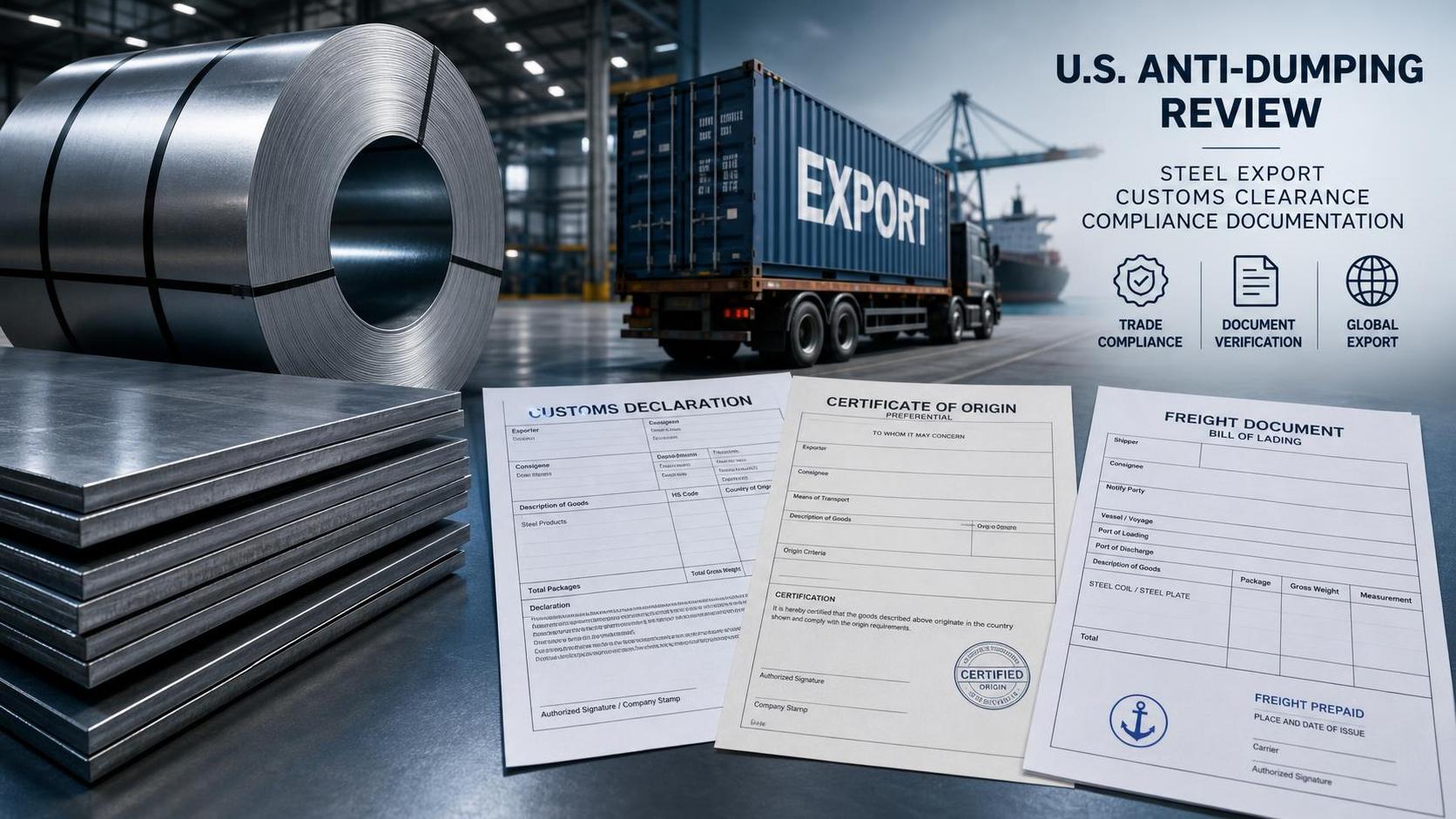
On July 29, 2026, the U.S. Department of Commerce announced the start of an anti-dumping administrative review covering Chinese hot-rolled steel coil under HS 7208.51-7208.90 for export shipments made from April 1, 2025 to March 31, 2026. For companies involved in exports to the U.S., importing, customs handling, and trade documentation, this is not just a procedural notice: it is a rule-driven development that may affect duty treatment from the fourth quarter of 2026, influence clearance timing, and raise the documentation threshold for affected transactions.

What Has Been Confirmed So Far
The confirmed facts are limited and clear. The U.S. Department of Commerce issued a notice on July 29, 2026 to formally initiate an anti-dumping administrative review of Chinese hot-rolled steel coil. The review applies to products classified under HS 7208.51-7208.90 and covers export batches shipped between April 1, 2025 and March 31, 2026.
According to the provided event summary, the review will directly affect the duty rate application for exports to the U.S. starting in the fourth quarter of 2026. It may also affect customs clearance timing and the compliance documentation required in connection with those shipments. Importers are expected to prepare certificates of origin, cost structure explanations, and supporting materials from third-party audits.
Where the Pressure May Appear in Actual Trade Flows
Export transactions may face closer scrutiny at the document level
From an industry perspective, exporters shipping the affected hot-rolled coil products to the U.S. are likely to feel the impact first in duty treatment and file preparation. The reason is straightforward: the review is tied to a defined shipment period and is described as having a direct effect on tax rate application from the fourth quarter of 2026. In practice, this means exporters may need to pay closer attention to how shipment records, product classification, origin evidence, and cost-related materials align across the transaction file.
What deserves closer attention is not only the commercial side of the shipment, but also whether internal records can support external declarations consistently if questions arise during review or clearance.
Importers and customs-facing teams may see timing and compliance risks
For importers, the event summary points directly to customs clearance timing and compliance file requirements. That makes this relevant not only to buying teams, but also to customs brokers, trade compliance managers, and logistics coordinators working on U.S.-bound steel transactions. If required supporting materials are incomplete or inconsistent, the practical impact may show up in filing delays, requests for supplementary explanation, or slower release processes.
Analysis shows that import-side preparation is likely to become more document-intensive. Certificates of origin, cost composition statements, and third-party audit support are not peripheral items here; they are the materials specifically highlighted in the event summary and therefore should be treated as priority compliance inputs.
Procurement and supply chain planning may need tighter coordination
For procurement teams and supply chain service providers, the issue is less about the announcement itself and more about how execution risk may move upstream into planning. If duty rate treatment and clearance timing are both affected from the fourth quarter of 2026, purchasing schedules, delivery commitments, and supplier communication may all need closer coordination around document readiness and shipment traceability.
Observably, this places added importance on whether suppliers can provide timely origin documentation, cost breakdown support, and audit-ready materials. Even where contracts are already in place, the operational burden may shift toward earlier document collection and more conservative delivery planning.
What Companies Should Watch Now
Keep shipment-period records organized and retrievable
The review covers exports made between April 1, 2025 and March 31, 2026. Companies connected to those shipments should pay attention to whether records for that period are complete, internally consistent, and easy to retrieve. This includes commercial records and the compliance materials specifically mentioned in the event summary.
Prepare origin, cost, and audit support before it becomes urgent
The event summary specifically notes certificates of origin, cost structure explanations, and third-party audit support materials. Companies should therefore treat these as immediate document priorities rather than waiting for later requests. Analysis shows that the main value of early preparation is not to predict an outcome, but to reduce friction if review-related checks begin to affect customs processing or importer requests.
Monitor how filing and clearance practice develops in the fourth quarter of 2026
No detailed execution framework beyond the provided summary is available here, so it would be premature to describe final procedures or outcomes. What is more appropriate to watch is whether official wording, customs practice, or transaction-level requirements become more specific as the fourth quarter of 2026 approaches.
Align internal teams around one trade file standard
For affected businesses, this is not only a legal or customs issue. Sales, logistics, procurement, finance, and compliance teams may all hold pieces of the required record trail. From an industry perspective, one practical step is to make sure these teams are working from the same product scope, shipment period, and supporting document standard so that external submissions do not conflict with internal records.
Why This Looks More Like an Execution Signal Than a Finished Outcome
Analysis shows that this development is better understood as an active enforcement and execution signal rather than a completed rule outcome. The announcement confirms that the review has been initiated and that it will matter for duty treatment, clearance timing, and compliance materials. However, it does not by itself establish every later operational detail that market participants may want to see.
What deserves closer attention is the shift in compliance expectations around affected shipments. Even without expanding beyond the confirmed facts, the event already points to a more documentation-sensitive trading environment for the covered product scope. That is why the industry will need to keep watching not only official follow-up language, but also how importers, customs-facing teams, and service providers begin translating the review into daily execution requirements.
How This Update Is Best Understood at This Stage
At this stage, the most balanced reading is that the review marks a concrete regulatory development with direct trade and compliance relevance, but not a fully settled end state. It matters because it creates a defined review framework tied to covered products, a specific shipment window, and expected downstream effects on duty treatment and documentation from the fourth quarter of 2026.
For the industry, the practical significance lies in preparation rather than assumption. It is more appropriate to understand this as a live rule-related development that already warrants document control, importer coordination, and closer observation of execution practice, while final operational implications still need to be tracked through subsequent implementation signals.
Basis of This Article and What Still Needs Verification
This article is based on the user-provided news title, event date, and event summary. It has not relied on any additional unverified policy number, company name, market data, institutional background, or external case detail.
For events of this kind, source types commonly relevant to further verification include official notices, releases by regulatory authorities, customs or trade-administration information, industry association updates, standard-setting documents, and reporting by authoritative trade media. A specific official source link was not provided in the input, so the exact original publication should still be checked on an ongoing basis.
Further observation is still needed on any later policy wording, implementation interpretation, customs execution practice, procurement document requirements, market feedback, and how affected companies actually respond in trade operations.
By clicking 'Allow All', you agree to the storage of cookies on your device to enhance site navigation, analyze site usage and assist with our marketing efforts. Coo Cookie Notice