



On July 30, 2026, the European Commission formally moved CBAM reporting for steel products into a mandatory phase, creating a concrete compliance change for Chinese exporters shipping steel and structural sections to the EU. For businesses dealing in products such as hot-rolled coil, H-beams, and angle steel, the issue is no longer only product delivery or price negotiation; quarterly carbon-related reporting now becomes part of the export process, with direct implications for documentation readiness, buyer acceptance, customs timing, and supply-chain coordination.
What the new filing requirement now covers
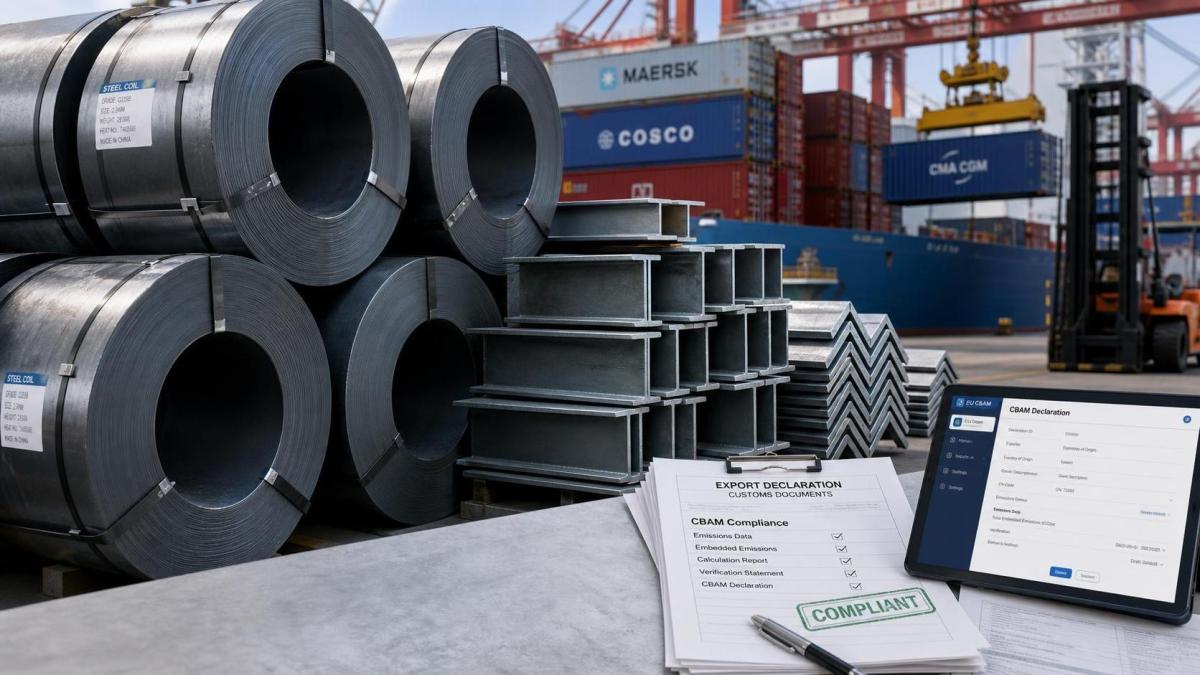
According to the provided information, from July 30, 2026, all Chinese exporters shipping steel products and sections to the EU must submit quarterly reports through the EU CBAM system. The reporting scope includes embedded carbon emissions, electricity source information, and upstream raw material data. The affected product range includes steel and sections such as hot-rolled coil, H-beams, and angle steel. The same information indicates that this requirement directly affects export compliance costs and delivery timing, and that companies that fail to complete registration or provide compliant data may face customs clearance delays and the risk of buyer rejection.
Where the pressure is likely to appear across transactions
Export shipments now depend on carbon data readiness
From an industry perspective, exporters are the first group exposed to the operational impact because the new requirement attaches quarterly CBAM reporting to outbound trade activity. The pressure is likely to show up in pre-shipment preparation, internal data collection, document review, and coordination with EU-side buyers. What deserves closer attention is that the risk is not limited to regulatory filing itself; incomplete registration or non-compliant data may also affect whether goods move on schedule and whether buyers are willing to receive them.
Upstream sourcing becomes part of the compliance chain
Analysis shows that raw material sourcing and electricity-use records become more relevant because the required filing includes upstream raw material data and power source information. For manufacturers and processors supplying export orders, this means procurement records, production information, and supporting technical documents may need to align more closely with export compliance needs. Even where the policy text provided here does not specify a detailed format, the practical implication is that upstream suppliers may be drawn into the reporting workflow.
Buyers and supply-chain coordinators face delivery and acceptance risk
Observably, EU buyers, traders, and supply-chain service participants may also be affected because customs timing and acceptance conditions can become more sensitive to document completeness. Where procurement contracts or shipment windows are tight, any mismatch in reporting information may create friction in order execution. The immediate concern is therefore not only regulatory awareness, but whether commercial and logistics arrangements are built around the new filing obligation.
What companies should be checking now
Registration and quarterly reporting workflows
Analysis shows that companies exporting covered steel products should pay close attention to whether internal registration and quarterly submission processes are complete and clearly assigned. Because the reported information must go through the EU CBAM system, businesses need to treat filing readiness as part of routine export administration rather than as a separate afterthought.
Consistency of emissions, electricity, and upstream records
What deserves closer attention is the consistency of the three data areas named in the provided information: embedded emissions, electricity sources, and upstream raw material data. Companies should review whether these records can be collected in a usable form and whether supporting documents are consistent across procurement, production, and export paperwork. The available information does not provide detailed verification rules, so this remains an area that requires ongoing attention rather than assumptions.
Delivery planning and buyer communication
From an industry perspective, delivery schedules may need additional buffer where reporting preparation is still immature. Exporters and traders should also watch how buyers reflect CBAM-related reporting expectations in purchase documents, order confirmations, and acceptance conditions. This is especially relevant because the stated risks include delayed customs clearance and refusal by purchasers to take delivery where registration or data compliance is not in place.
Document control around covered product lines
Analysis shows that businesses handling steel categories such as hot-rolled coil, H-beams, and angle steel should identify which product lines are directly exposed and whether their supporting files are managed consistently. The provided information does not define a broader implementation result, so companies should treat document control, traceability, and reporting readiness as active checkpoints rather than settled practice.
Why this reads as an execution signal rather than a distant policy headline
Observably, this development is more appropriately understood as an implementation-stage compliance signal, not merely a policy statement. The reason is straightforward: the requirement is tied to mandatory quarterly reporting, named data fields, and operational consequences for export clearance and buyer acceptance. At the same time, analysis shows that the market still needs to watch how filing expectations are interpreted in practice, including any further clarification in official wording, transaction documents, and day-to-day enforcement.
How the market is likely to read this change for now
At this stage, the most balanced reading is that CBAM reporting for steel exports has moved closer to routine trade execution and away from abstract policy discussion. The significance lies in the shift of carbon-related information into the core export workflow for covered steel products. It is more appropriate to understand this as a landed compliance change with continuing practical questions, rather than as a fully settled framework with all execution details already clarified.
Basis of this article and points still requiring verification
This article is based on the user-provided news title, event date, and event summary. For developments of this type, relevant source categories typically include official announcements, releases from regulatory authorities, customs or trade-administration information, industry association updates, standards-related documents, and reporting by authoritative media. No specific official source link was provided in the input, so the exact official publication path still needs to be verified on an ongoing basis. Continued observation is also needed around implementation detail, reporting interpretation, buyer documentation requirements, tender-language changes, industry feedback, and how companies are handling execution in practice.
By clicking 'Allow All', you agree to the storage of cookies on your device to enhance site navigation, analyze site usage and assist with our marketing efforts. Coo Cookie Notice